


Hamptons vs Montauk: Which Long Island Getaway Fits You Best?

Both the Hamptons and Montauk sit at the eastern tip of Long Island’s South Fork, close enough on a map that you could drive between them in under an hour. In practice, they feel like two entirely different worlds. One runs on social currency and designer sunglasses; the other smells like saltwater, sunscreen, and fresh-caught striped bass.
Figuring out the Hamptons vs Montauk debate comes down to one honest question: what do you actually want from a summer escape?
The Hamptons: Refined, Social, and Upscale
The Hamptons is not one town; it’s a collection of villages spread across Southampton and East Hampton townships: Bridgehampton, Amagansett, Sag Harbor, and Water Mill, among others. Together, they form one of the most recognizable resort communities in the United States.
The Scene
Preppy and elite. Manicured hedgerows line the backstreets, boutique hotels occupy historic estates, and the restaurant scene draws chefs who could fill a Manhattan reservation list overnight. This is where the city’s professional class comes to socialize under the guise of relaxation: deal-making over rosé at Wolffer Estate, gallery-hopping in East Hampton, and being seen at the right farm stand on a Saturday morning.
Beaches and Things to Do
Coopers Beach in Southampton offers wide quartz sand, lifeguards, chair rentals, and a café. Main Beach in East Hampton draws a similar crowd. The catch: non-resident parking runs $40 per day in peak season, so plan accordingly.
Walk one block back from either beach, and the scene shifts entirely: wide, leafy streets, towering hedges, and some of the most expensive real estate in the country. Beyond the sand, most itineraries lean cultural and culinary: wine tasting on the North Fork, farm-stand tours, gallery openings, and boutique shopping in East Hampton village.
The Hamptons Classic Horse Show, each August in Bridgehampton, doubles as a societal event and a genuine equestrian competition worth attending even if horses aren’t your thing.
Getting There and Staying
Traffic on Route 27 in July and August is notoriously brutal, and there’s no practical way to move between villages and between JFK and The Hamptons without a vehicle. Arriving via Hampton Jitney helps with the drive in from the city, but once you’re there, driving or ride-sharing is unavoidable. Accommodation skews toward boutique inns, luxury rental properties, and historic estates; budget options are scarce in peak season, and “mid-range” carries a different meaning here than it does most anywhere else in New York.
- Best for: Visitors who want a community scene, fine dining, cultural programming, and don’t mind spending accordingly. Also well-suited to wine lovers, art collectors, and anyone who treats “summering” as an active pursuit rather than passive rest.
Montauk: Raw, Relaxed, and Itself
Montauk sits at the absolute eastern tip of Long Island: further out than any other Hamptons community, which partly explains why it developed differently. For most of its history, it was a working fishing village, and despite rising popularity and real-estate prices, much of that identity survives. You’ll still find family-owned seafood shacks sitting alongside upscale resorts, local fishermen unloading catch at the dock, and surfers who’ve been riding Ditch Plains for decades. The dress code at most restaurants is a dry swimsuit and flip-flops. Even with more upscale hotels and restaurants, Montauk still feels less concerned with appearances than the villages farther west.
On the Water
Surfing pulls a lot of people here, and Ditch Plains Beach is where most of them end up: a long, consistent break that works for beginners taking lessons and experienced longboarders alike. The break near Turtle Cove at Camp Hero State Park, the one that appears in countless photographs with the lighthouse in the background, is a different story: boulders, rip tides, and no margin for error. Stick to Ditch Plains if you’re still learning.
Fishing is equally serious. Lake Montauk and the surrounding offshore waters support a full charter industry, and the striped bass season in the fall draws anglers from across the Northeast who treat the trip like a pilgrimage. After a day out, the West Lake Fish House near the docks takes care of the debrief: clam chowder, fish tacos, whatever came in that morning.
Land, Logistics, and Where to Sleep
Camp Hero State Park is a decommissioned World War II military base covering 415 acres of coastal forest, blufftop trails, and leftover infrastructure: bunkers, gun batteries, and a radar tower that you can photograph but not enter.
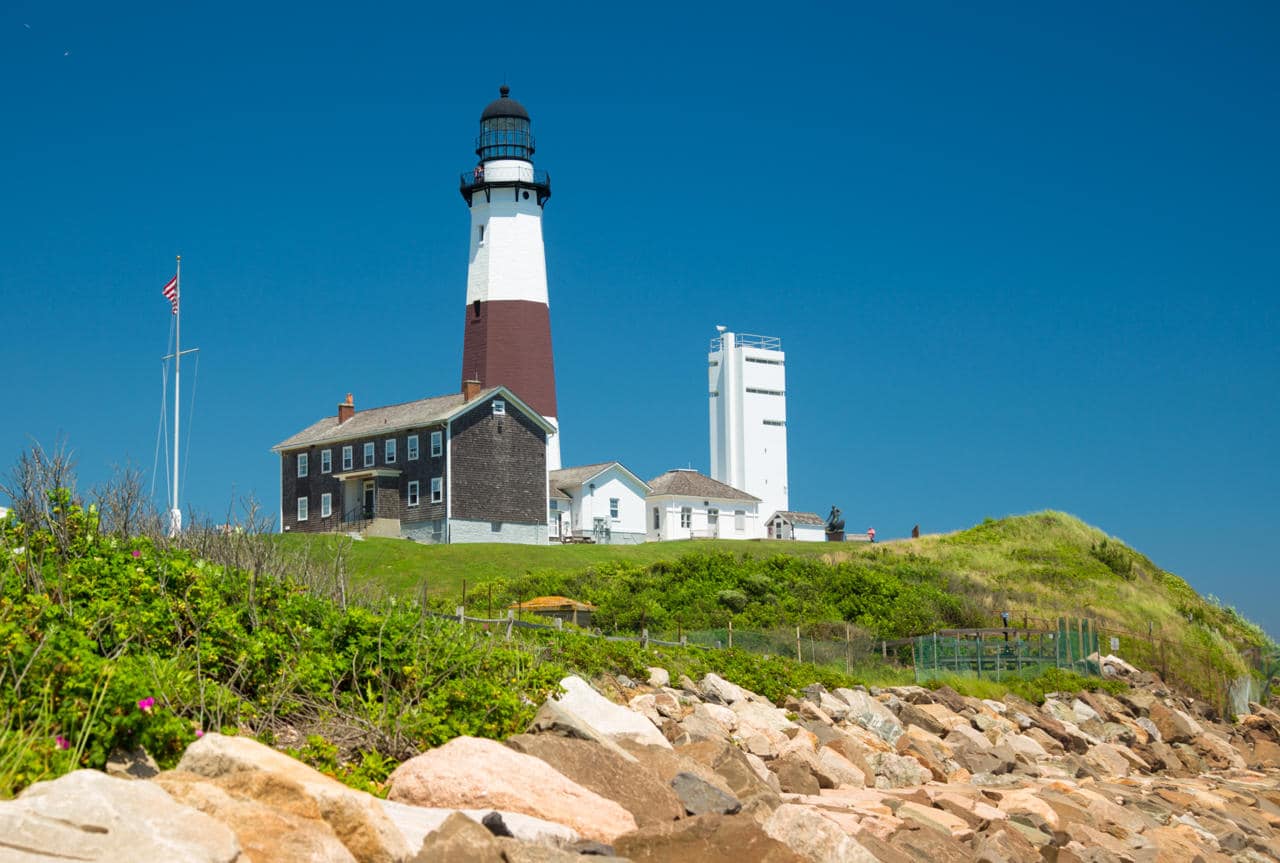
Just east, Montauk Point State Park wraps around the Montauk Point Lighthouse, the oldest in New York State, commissioned by President George Washington in 1792. The view from the top takes in the Atlantic and Block Island Sound. The Paumanok Path, Long Island’s primary long-distance trail, starts here and runs 125 miles west.
Getting here takes roughly 3.5 hours from New York City in off-peak traffic. The Hampton Jitney runs a direct route from Midtown in about three hours, and the Long Island Rail Road serves the town from Penn Station during the summer.
Accommodation is surprisingly varied for a place this size: Gurney’s Montauk Resort & Seawater Spa anchors the luxury end, while surf lodges, casual motels, and vacation rentals cover a wide price range that the core Hamptons villages rarely match.
- Best for: Surfers, anglers, hikers, families who want the beach without the social performance, and anyone who finds that the less refined a place is, the more they trust it.
Which One Fits Your Trip Best?
- Atmosphere: The Hamptons runs upscale and curated. Montauk is casual, rugged, and laid-back.
- Top draw: Fine dining, boutique shopping, and gallery culture in the Hamptons; surfing, sport fishing, and coastal hiking in Montauk.
- Signature beach: Coopers Beach and Main Beach for the Hamptons; Ditch Plains for Montauk.
- Iconic landmark: East Hampton village’s main street versus the Montauk Point Lighthouse.
- Accommodation range: The Hamptons skews toward boutique luxury and high-end rentals. Montauk spans budget motels all the way up to Gurney’s full-service oceanfront resort.
- Traffic: Both get congested in July and August, but Route 27 through the Hamptons villages is notoriously worse. Montauk improves significantly in the shoulder season.
- Drive from NYC: Roughly 2-2.5 hours to the Hamptons in off-peak traffic; 3-3.5 hours to Montauk under the same conditions.
So, choose the Hamptons if…
- You want fine dining, galleries, and social energy.
- You are comfortable with higher prices.
- You plan around reservations and events.
- You care about shopping and cultural programming.
And choose Montauk if…
- You want surfing, fishing, hiking, and a loose beach feel.
- You want more lodging variety.
- You want more outdoor time and less pressure.
- You care about water, trails, docks, and scenery.
Can You Do Both? Absolutely.
The two aren’t mutually exclusive. Base yourself in Montauk and spend a day driving west through Amagansett into East Hampton for a meal and some shopping. Or stay in East Hampton and make a one-day trip out to the lighthouse and Ditch Plains. The farther east you go, the more the South Fork changes character.
Either way, book early. Summer inventory on the South Fork fills up months in advance, and prices reflect that demand without apology.
Categories
- New York Limousine Service (61)
- Long Island Limo Service (31)
- Things To Do In Long Island (15)
- Airport Limo Car Service (13)
- Travel Tips (12)
- Bronx Limo Service (8)
- Concert Transportation (8)
- Hampton Car Service New York (7)
- Corporate Transportation (6)
- Holidays (6)
- JFK Airport Transportation (5)
- New York Airport Transportation (4)
- Business Travel (3)
- Business Meetings (3)
- JFK Limo Service (2)
- Things To Do In Southampton (2)
- LGA Airport (1)